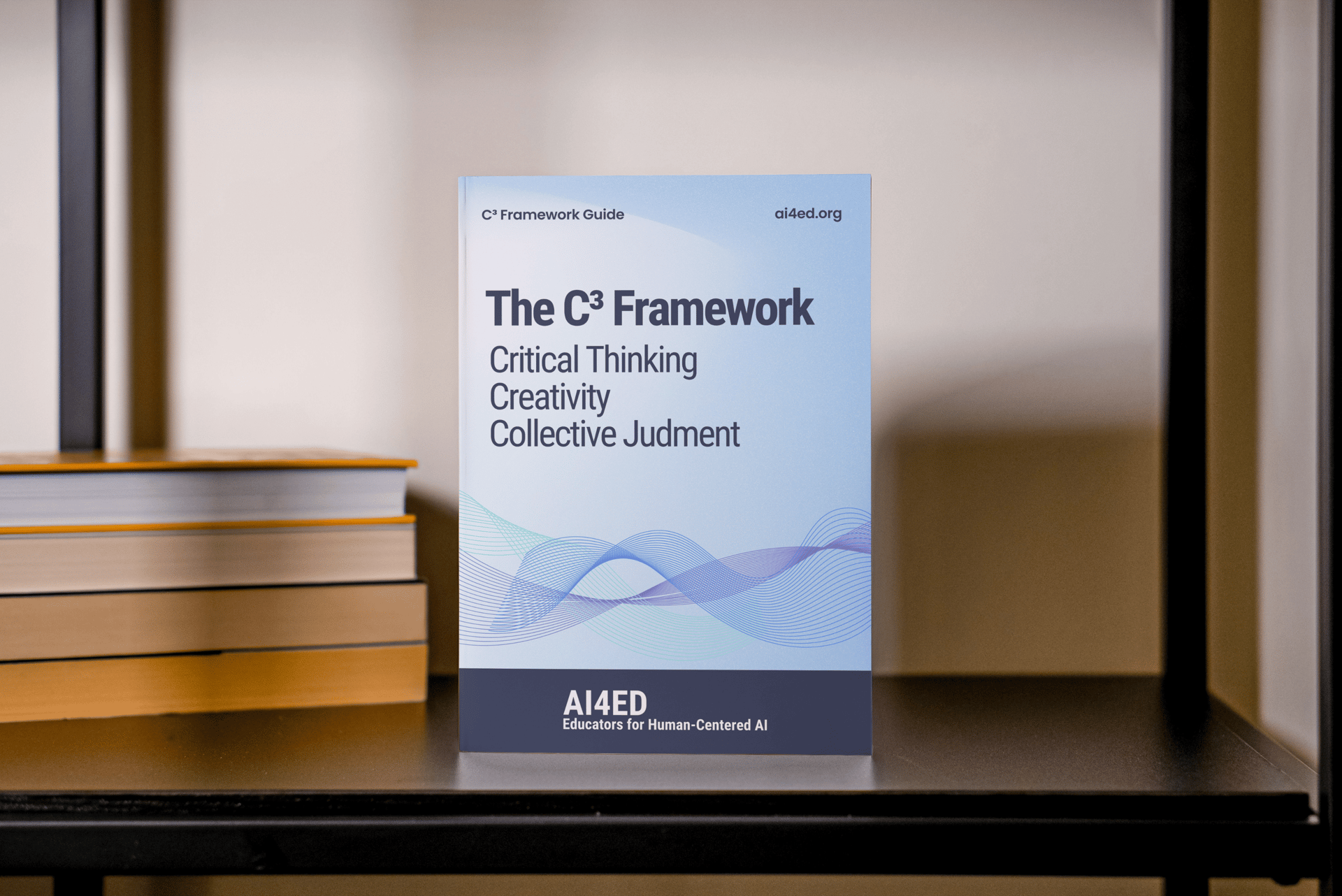
The C³ Framework: Protecting what Matters Most in an AI World
Artificial intelligence is not just a new classroom tool, it changes how knowledge is generated, accessed, and evaluated.
Student-centered AI is not about adopting tools, it is about designing systems that strengthen thinking.
The C³ Framework provides a disciplined model for integrating AI in ways that protect and strengthen the cognitive foundations of learning.
AI systems can now generate essays, code, explanations, lesson plans, and multimedia in seconds.
If instructional design does not change, students may no longer need to:
• Wrestle with complexity
• Sustain attention
• Verify claims
• Generate original thought
The risk is not simply academic dishonesty.
The risk is cognitive erosion.
The C³ Framework was created to ensure that AI strengthens, rather than weakens, the habits of mind schools exist to cultivate.
The Challenge Facing Schools


These Are the Non-Negotiables
Every AI decision — instructional, systemic, or policy-related — should reinforce three essential outcomes:
Critical Thinking


In a student-centered AI model, students do not passively accept outputs. They interrogate them.
Students learn to:
• Cross-check claims against credible sources
• Identify hallucinations and confident misstatements
• Distinguish between synthesis and verified evidence
• Evaluate reasoning quality
• Explain what they accept or reject — and why
AI becomes a tool for analysis, not a substitute for thought.
Observable indicators include:
• Students citing independent evidence beyond AI output
• Students articulating limitations in AI-generated responses
• Classroom routines that require verification before submission




Creativity
Creativity in an AI era is not about avoiding technology. It is about retaining authorship and direction.
Students use AI to:
• Brainstorm alternatives
• Generate multiple design options
• Prototype ideas
• Remix concepts across disciplines
But they remain responsible for:
• Purpose
• Voice
• Judgment
• Final synthesis
AI expands possibility space, it does not replace originality.
Observable indicators include:
• Iterative drafts showing decision-making
• Reflection explaining creative choices
• Work that reflects distinctive perspective rather than generic output
Collective judgment is the capacity to make responsible decisions within shared norms.
Students learn to:
• Recognize bias in AI systems
• Understand that AI is not a primary source
• Apply academic integrity standards
• Disclose AI use transparently
• Make informed choices about when AI is appropriate
AI use becomes intentional, not automatic.
Observable indicators include:
• Appropriate disclosure of AI assistance
• Clear evidence vs. synthesis distinction
• Ethical decision-making in collaborative contexts
Collective Judgment
The Three Domains of Design
Outcomes do not happen accidentally.
They require intentional system design.
The C³ Framework operates across three interconnected domains:
Cognitive Design
Focus: Instruction and Learning Tasks
This domain asks a central question:
Does this AI integration deepen thinking, or shortcut it?
Cognitive Design ensures:
• Assignments require reasoning and justification
• Verification routines are embedded
• Productive struggle is preserved
• Students explain their decisions
• AI use aligns with learning goals
If a student can complete an assignment by prompting once and copying the result, the task likely measures AI access more than learning.
Cognitive design makes thinking visible.


System Design
Focus: Infrastructure, Professional Learning, and Assessment
Tool access without training creates fragmentation. Training without assessment redesign creates misalignment.
System Design addresses:
• Teacher AI literacy development
• Professional learning structures
• AI-resilient performance tasks
• Assessment redesign
• Secure infrastructure and privacy safeguards
AI integration cannot rely on informal adoption.
System-level coherence determines impact.
Focus: Guardrails and Transparency
Governance is not restriction.
It is clarity.
Effective governance includes:
• Clear student-facing expectations
• Disclosure norms for AI use
• Explicit guidance that AI is not a primary source
• Data privacy protections
• Age-appropriate supervision
• Consistent academic integrity standards
Transparency builds trust.
Clarity enables responsible use.
Governance & Ethics


The Six Design Principles
Amplify, Don't Replace
AI should expand thinking, not replace it.
Preserve Productive Struggle
Some friction is necessary for cognitive growth.
Teach the System, Not Just the Tool
Students must understand where AI works and where it fails.
Design for Verification
AI output should be evaluated, cited, and challenged.
Build AI Literacy for All
Students and educators require structured instruction in prompting, bias, and limitations.
Govern with Transparency
Clear expectations build trust and encourage responsible use.
The C³ Framework includes a structured 90-day launch roadmap for districts ready to move from reactive policy to coherent design.
The process focuses on:
• Aligning leadership around C³ outcomes
• Building foundational AI literacy
• Redesigning selected assignments
• Establishing governance clarity
• Scaling with coherence
Implementation is iterative, not impulsive.






Student-centered AI requires courage.
It requires leaders to move beyond panic, beyond novelty, and beyond efficiency metrics.
The C³ Framework offers a disciplined alternative:
Define the outcomes.
Design instruction and systems intentionally.
Govern with clarity.
Protect human judgment.
The future of education in an AI world will belong to leaders who protect thinking while embracing innovation.